Open Quote
Automation Workflow
ROLE
Designer & Marketing Automation Lead — Strategy, Workflow Architecture, Creative & Collateral
DELIVERABLES
Workflow logic · 3 email designs · Custom HubSpot forms · Supporting sales collateral
TIMELINE
Summer 2025
50%
of contacts converted to a closed sale
178
contacts through the workflow
51%
peak email open rate -
Email 3
2x
redeployed Summer 2026 by leadership request
THE SITUATION
Quotes going out.
Deals going quiet.
Revenue sitting on the table.
Every sales team has the same problem: quotes go out, and then go quiet. A prospect requests pricing, receives a proposal, and then — nothing. No reply. No decision. The sale sits open, aging on a report, while the sales team moves on to the next lead.
At Rydin, open quotes represented a meaningful pool of warm prospects — people who had already expressed enough interest to request a proposal. They weren't cold leads. They just needed the right follow-up at the right time, delivered the right way.
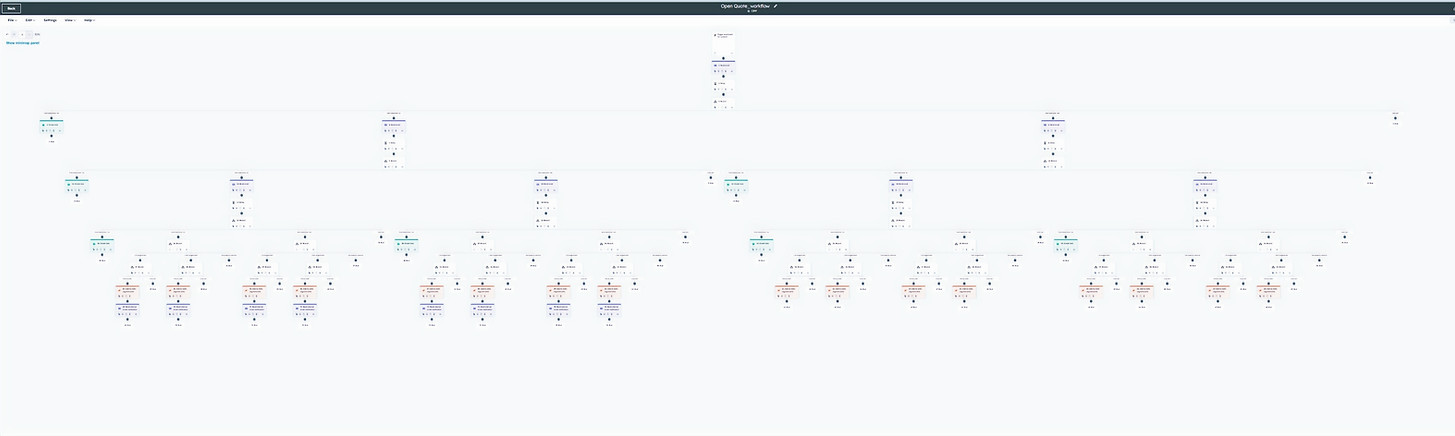
Leadership identified the opportunity and asked me to build a solution. What I built wasn't just an email campaign — it was a logic-driven automated workflow that moved prospects through a personalized follow-up sequence based on their behavior, keeping them engaged until they either closed the sale or opted out.


MY ROLE
One person. Every piece of the system.
I owned this project end to end — from understanding the business problem to designing the workflow logic to producing every piece of creative that supported it. My deliverables included:
-
Workflow architecture — mapping the logic, defining the triggers, building and testing the full sequence in HubSpot
-
Email design — designing all three emails in the sequence, on-brand and built for performance
-
Custom HubSpot forms — building intake and tracking forms that fed contact data into the workflow and kept the CRM accurate throughout
-
Supporting sales collateral — designing print and digital materials the sales team used alongside the automated follow-up
This wasn't a hand-off project. The workflow logic, the creative, the forms, and the collateral were all built by the same person — which meant every element was designed to work together rather than cobbled together from separate teams.
THE THREE-EMAIL SEQUENCE
Logic-driven follow-up that built momentum with every send.
01
THE SOFT CHECK-IN
Re-open the conversation without creating pressure.
Sent shortly after the last sales rep contact with no response. Warm, low-pressure tone — designed to feel like a personal follow-up, not a marketing blast. One ask: are you still interested?
42%
OPEN RATE
15%
CLICK-THROUGH RATE
02
THE VALUE REINFORCEMENT
Address hesitation before they voice it.
Sent only to contacts who didn't respond. Reinforced Rydin's value proposition with a specific proof point relevant to the prospect's inquiry — reliability, precision, support. Answers the question: why Rydin over a competitor?
30%
OPEN RATE
8.33%
CLICK-THROUGH RATE
03
THE DIRECT ASK
Create a decision point.
Sent to contacts who engaged or still hadn't responded. Clear, confident, concise. A direct invitation to reconnect — a call, a question answered, a revised proposal if needed. Either move forward, or opt out cleanly.
51%
OPEN RATE
45.85%
CLICK-THROUGH RATE
BRANCHING LOGIC - WHAT HAPPENS BETWEEN EMAILS
-
Contacts who responded at any stage were immediately removed from the workflow and handed back to the sales team
-
Contacts who clicked but didn't reply, were reported to Sales team before continuing in the main sequence
-
Contacts who didn't open after a set number of days were flagged for sales team review
-
Unsubscribes and bounces were handled automatically with separate lists, nor further processing in automation

FULL PROJECT SCOPE
Every deliverable, built by one creative lead.
AUTOMATION
HubSpot Workflow Architecture
Full logic map, trigger definitions, branching conditions, and workflow build in HubSpot — tested before launch.
DESIGN
3 Email Designs
On-brand, mobile-first email layouts — single CTA per email, conversational tone, designed to feel human not automated..
DEVELOPMENT
Custom HubSpot Forms
Custom-built intake and tracking forms — branded, configured to feed the right data fields into workflow triggers and Salesforce.
CREATIVE
Sales Collateral
Supporting print and digital materials for the sales team — consistent with email design and Brand Book standards throughout.
SALESFORCE INTEGRATION
Closing the loop between creative and sales.
The workflow was integrated with Salesforce so that contact activity — opens, clicks, replies — fed directly into the CRM. Sales reps could see exactly where a prospect was in the sequence and what they had engaged with before picking up the phone.
This closed the loop between marketing automation and sales follow-up, making the handoff seamless rather than siloed. A rep calling a prospect who had opened Email 3 and clicked through knew something important: this person was warm, engaged, and close to a decision.
The result was a more informed sales conversation — and a higher likelihood of closing it.

THE OUTCOME
90 closed sales from 178 stalled prospects.
90
Contacts Closed a Sale
Out of 178 contacts
51%
Peak Email Open Rate
2x B2B Industry Average
45.85%
Peak Click-Through Rate
Email 3
2026
Redeployed by
Leadership Request
Peak Busy Season
THE PERFORMANCE BREAKDOWN
Email | Purpose | Open Rate | Click-Through Rate | vs B2B Average |
|---|---|---|---|---|
Email 1 -- Soft check-in | Re-open the conversation | 42% | 15% | +17pp above average |
Email 2 -- Value Reinforcement | Address Hestitation | 30% | 8.33% | +5pp above average |
Email 3 -- Direct Ask | Create a decision point | 51% | 45.85% | +26pp above average |
B2B email marketing industry average open rate: ~20–25% · Industry average click-through rate: ~2–5%
The progression across the three emails tells the story of a workflow that filtered and built engagement rather than fatiguing it. Email 1 opened strong at 42%. Email 2 settled as less-engaged contacts fell away naturally. Email 3 peaked at 51% open and 45.85% click-through — meaning the prospects who reached the final email were highly engaged and ready to act.
That progression wasn't accidental. It was the result of behavioral logic designed to route the right message to the right person at the right moment — not a fixed schedule firing at everyone regardless of what they did.
WHAT MADE IT WORK
Four decisions that separated this from a standard email drip.
The logic was built around behavior, not time
Most automated sequences fire on a fixed schedule regardless of what the prospect does. This workflow responded to behavior — a contact who opened and clicked got a different next step than one who ignored the email entirely. That responsiveness made the sequence feel like attentive follow-up, not automation.
1
The emails were designed to feel human
Automated emails are easy to spot — and easy to ignore. Each email was designed with a single-column layout, conversational tone, and one clear ask. No banners, no promotional graphics, no "CLICK HERE" buttons. The design restraint was intentional — and the open rates reflect it.
2
The creative and the logic were built together
Because I owned both the workflow architecture and the email design, the messaging and the timing were developed in parallel. The tone of each email was shaped by where a prospect was in the sequence — which meant the creative reinforced the logic rather than fighting it..
3
Everything came from one creative hand
The workflow, emails, forms, and collateral were all designed and built by the same person. That consistency — in visual language, tone, and timing — is what made the system feel cohesive. When every touchpoint matches, the brand feels intentional. The close rate reflects that cohesion.
4
SUMMER 2026
From a campaign to a business asset.
The results from Summer 2025 were strong enough that leadership requested the workflow be rebuilt, customized, and redeployed for Summer 2026 — timed to Rydin's peak market busy season.
A one-time campaign becoming a repeatable business tool is the clearest possible signal that the work delivered real value. It's one thing to build something that works once. It's another for leadership to look at the results and ask you to make it better.
CHANGE 1 - TRIGGER TIMING
The first email now fires sooner — timed to the last sales rep contact rather than the quote open date. This closes the gap between human outreach and automated follow-up while the prospect's interest is still warm.
CHANGE 2- EMAIL COPY REFINEMENTS
Targeted copy edits to each email, sharpening the messaging based on what resonated in 2025. Small changes, deliberately chosen — the kind that come from actually reading the data rather than just running the report.
REFLECTION
"The 2026 redeployment request is the part I'm most proud of. It's one thing to build something that works once. It's another for leadership to look at the results, decide the workflow is worth investing in again, and ask you to make it better. That's when a project stops being a campaign and becomes a business asset."
This project confirmed something I'd suspected: the gap between a good marketing idea and a successful marketing outcome is almost always execution. The insight — follow up on open quotes — wasn't new. What made it work was the specificity of the logic, the quality of the creative, and the integration between the two.
TOOL USED
HUBSPOT
SALESFORCE
ADOBE ILLUSTRATOR
ADOBE PHOTOSHOP